
SEO and me
March 13, 2024
I have subscribed to a few podcast newsletters, the type with news of the industry, helpful hints for streamlining the work and marketing, you get the idea.
In the podcast space these days there’s a lot of these optimal practices that will win you lots of attention and a bigger audience, all in the name of monetization. Part of that push is to spend a lot of time, even use AI, to find the right episode titles to maximize Search Engine Optimization (SEO.)
When I read or hear about this and all the advice that goes with it, it gives me pause. I have worked hard at developing my voice as a writer and, as an extension of that, a podcaster. My goal as a storyteller hasn’t been to become the darling of the masses (i would take the job if offered, though.) My goal is to tell a good story about a subject you probably don’t know much about or never even heard of and to allow it to open your eyes to the significance it might hold.
I think that’s a very human thing. I think it’s something that would appeal to naturally curious, the kind of person that is drawn to that brand of storytelling.
So, I tell myself, I’m going against the grain here, thumbing my nose at conventional wisdom.
The best way to tell how out of step I am with the generally accepted trends in the business are my titles. Back in Jr. High and High School my English teachers would emphasize creating a title that invites the reader in. It’s a practice I can’t seem to give up.
I recently did an episode about a band of Kickapoo Indians helping the new settlers of Nicodemus, Kansas by giving them a goodly portion of the take of their annual buffalo hunt. They were, the Kickapoos said, compelled to do so by the Great Spirit. The town was saved, however it was to be the tribe’s last buffalo hunt.
I originally decided to title the episode “The Buffalo Hunt.” I felt that it was an accurate title, but it wouldn’t draw in a listener. After a little bit of Facebook input, I went with “With a Little Help From The Great Spirit.” The second title was much less SEO friendly than the first, but, honestly, I felt it more described the type of story I was telling.
Most of my titles are like that, going against the grain.
And I don’t think that’s going to change anytime soon. I fell like it appeals to the curiosity and humanness of the listener (or reader.) That’s more my goal, to give someone something to think about, maybe have them change their outlook based on a new perspective that I have provided.
Don’t hear what I’m not saying…I would love to have a continually growing audience. I want them to be here for the right reasons, not so I can brag how many listeners I was able to attract using internet market skills.
If you are one of those hardy soles that wants to hear stories that are uplifting, thought-provoking or touching, welcome aboard.
A Special Thank you to the Good folks in siloam springs
Last weekend we had a GREAT turn out at Olive and Opal in beautiful downtown Siloam Springs, Arkansas to hear my presentation about Ozark Giraffe Houses, sponsored by the Siloam Springs Museum. Siloam Springs is one of those places where the endangered Giraffe Houses still thrive and the turn out showed there is a lot of love for this Ozark vernacular architecture style.
Lots of good talk after the presentation and friends I haven’t seen in years in attendance. Good things all around. Olive and Opal not only serves excellent food and beverages but serves also as an art gallery, several very good pieces and photos line the walls.
If you find yourself in beautiful downtown Siloam Springs, be sure to stop in both the Siloam Springs Museum( https://www.siloamspringsmuseum.com/) and Olive and Opal (https://www.olive-and-opal.com/)
OZARK GIRAFFE TALK THIS SATURDAY IN SILOAM SPRINGS
Just a quick note to remind you that I will be charmingly ranting and raving about the Fabulous Ozark Giraffe homes in Siloam Springs, Arkansas, this Saturday. We’ll be at Olive and Opal’s in beautiful down town Siloam at 6:00 PM. That address is 300 E. Main. I’m pretty excited about the prospect and I’m looking forward to seeing you there!
I’ll Be Speaking On the Endangered Ozark Giraffe In Siloam Springs, March 2

Looking forward to this event! If you’re in the area come out and see us!
I Made It To The Local Paper!

History can be fascinating, especially when told from a humorous perspective, as Steve Garrett does in his podcast, “Within the Realm.”
He started the podcast in early 2018 and has published more than 100 episodes, which can be found on his website or on nearly any podcast platform, like Apple or Spotify. The podcast features stories about Stilwell – and other areas of interest to Garrett – that connect people.
“It’s all within the realm,” Garrett said.
He started the podcast after his son, Jacob, passed away.
“I wanted to do something to honor him and his creativity. He was a musician; he dabbled in film making and other pursuits, but mainly was a musician and songwriter,” he said.
Garrett felt he needed to do something creative.
“Taking some of the recording equipment of Jacob’s and the help of his bandmates, I was able to start recording these stories I have collected over a lifetime. I put them out there in the ether, and they started resonating with people,” he said.
Ozark Giraffe houses – the rock structures built with creative stonework resembling the hide of a giraffe – is an example.
“I present things I know about. I say the show comes from where the Great Plains, the Ozark Mountains and the Indian Territory collide. The stories and thoughts come from these places I have known and where my family had settled,” said Garrett.
The topics are about things he learned or observed while growing up.
“I covered the Going Snake Massacre, Sequoyah’s syllabary – things we take for granted in our part of the world, to tell about the resiliency and strength of character of the folks from this place,” he said.
He attempts to tell the story from a point of view different than the usual narrative.
“Much of the time, our stories get told by others. They talk about the ‘outlaw’ Zeke Proctor. Here in our county, he was a dangerous man, but was actually elected by his neighbors as sheriff and senator for his district. The truth always makes a better story,” he said.
Garrett is also a musician, and he enjoys the challenge of putting together the story in a way that gets the point across.
“Here in our corner of the world, we tell stories, and I want to continue and expand on that. It’s gratifying to know that these things I put together are enjoyed by others,” he said.
A script is written, as opposed to ad libbing as he goes, although he may toss in a bit of humor or detail if it comes to mind during the taping.
“I’m not quick enough to do it off the cuff,” he said.
Decades have gone into developing his talents as a storyteller.
“Storytelling is in the DNA of these hills, so I think I came by it honestly. Lots of good storytellers in the Adair family, my grandmother’s people. And living next door to J.L. Hallford, one of the greatest all-time storytellers, didn’t hurt, either,” said Garrett, adding in jest, “I just assumed everyone always wanted to hear what was on my mind.”
Ideas for the podcasts are inspired by events, people and places.
“Many of them have been floating around in my head for years, even before I knew what a podcast was,” he said.
Sometimes he comes across something and begins researching it, like the episode about shopping carts.
“When I worked at Walmart, I rounded them up and pushed them back to the store, but then I got to looking more closely at them. They are part of our everyday lives, but they are amazing things that changed the way we shop. And it all started in a grocery store in Oklahoma City,” he said.
Garrett has received quite a bit of positive feedback from folks who enjoy the stories and the way he tells them.
“I’m always eager to hear from folks, especially if they have some new info on a story I have presented,” he said.
He is married to Angel, a kindergarten teacher, and they are parents to three sons.
“I consult with local governments in the region to improve services for citizens and am always on the scout for a good tale,” said Garrett.
Reach out to Garrett at contact@withinpodcast.com or on his Facebook page.
Submitted by the city of Stilwell.
8’S tHE pLACE; A sense of Community
Those of us who grew up in Oklahoma’s “Green Country” in the 70’s remember the ABC affiliate KTUL Channel 8 well. The recent news that the offices and studios of Tulsa’s once pre-eminent television station are to be closed and will be operated out of Oklahoma City has resulted in commentary from many folks, most lamenting the passage of a serious piece of our collective history.
At the time, the 70’s that is, they boasted the tallest broadcasting tower, also the tallest structure in the state, in the area. Even out in the hinter lands, we could pick up the signal well. It was our link to the outside world.
The station was owned by James Leake, a local owner of such things. Leake was a promotor from the old school. He was a showman and figured prominently in the Green Country community. He also knew how to let others shine.
Television was our link to the outside world, but Channel 8 provided a link to our local vicinity.
In the early days of TV, the 50’s, local programming was a big thing, a hold-over from radio days. As time marched on and there was plenty of content available to be run, game shows. talk shows, what have you, the chore and expense of producing local shows led to fewer and fewer of them, outside of the local news, being produced.
But this was not the case with KTUL. Even into the 1980s, locally produced shows were strong. Channel 8 was about as interactive as television could get.
From early in the morning we were tuned into the John Chick Show, a country music program, which featured local artists and bands and the royalty from every little rodeo in the area. There were lots of local faces on the show. That was followed by the Betty Boyd show, a talk show featuring local topics and guests. In the afternoon, the were Mr. Zing and Tuffy and later Uncle Zeb’s Cartoon Camp, show that interspersed cartoons with kids from all over the area appearing at the show and getting to be on camera to give a warm greeting to their friends.
I was on the Uncle Zeb show with my Cub Scout group. At the end of the show, kids were allowed to walk across “the bridge,” with Uncle Zeb himself holding the mic, you could state your name and say hi to your family and friends.
At the time, I suffered from what we called a speech defect (which was later softened to speech impediment for the younger crowd,) I hadn’t yet mastered the “r” sound. I had no intention of appearing on the Uncle Zeb show and embarrassing myself before the entire world sounding like Elmer Fudd. For days I struggled with how I, Steve GARRETT would say hello to all my FRIENDS. The answer finally came to me; I would drop the surname entirely and use an “r-less” euphemism for tolerated acquaintances. With confidence, I crossed Zeb’s bridge and announced, “My name is Steve and I would like to say Hello to all my pals.”
I had never before or since referred to my associates as pals, but it did the trick.
There were other local shows as well, such as the Dr. Mazzeppa Pompezoidi’s Uncanny Film Festival and Camp Meeting. This late night Saturday show produced Gailard Sartain and Gary Busey and a lot of off the wall comedy. There is an entire generation of people here in Green Country who know Gary Busey best as “Teddy Jack Eddy” and yell “Law-zee!” at the screen when his face appears.
How many kids watched the weather waiting for Don Woods to call their name as the recipient of that evening’s “Gusty” drawing. With each forecast, the weatherman would draw his character Gusty preparing to enjoy sunshine or rain or jumping into the “fraidy hole” in bad storms.
The news anchors were constantly in the little towns that dotted KTUL’s broadcast area. Bob Hower would fly his yellow bi-plane over parades and other events, with the 8’s the Place logo emblazoned on it’s wings. John Chick, as Mr. Zing, appeared at many a grocery store opening in non-descript Oklahoma towns to the delight of his young audience. So strong was the tie to these local shows that when ABC launched it’s Good Morning America show in response to NBC’s success with the Today show, KTUL kept airing the John Chick Show because it’s ratings were better than the national offering.
In that Tulsa is very much a small town, Channel 8’s focus on local shows and promotions helped make it more so. To brag that our big sister had been on the John Chick show or to laugh about the Mazzepa skit with friends gave us all a wider community that we could take part in.
And now, they will run the corporate content over those same airwaves from Oklahoma City. A sign of the times, for sure.
But there is a lesson here.
A following has to be built and maintained. When news anchors didn’t want to show up in Hulbert for the Homecoming parade, an opportunity was missed. When our talk of Mazzeppa was replaced by rehashing jokes from Saturday Night Live, the local flavor disappeared. When kids no longer watched to see their friends on Uncle Zeb’s Cartoon Camp, they watched something else that drew their attention to places far from home.
Because we live in a locality, because our businesses are located somewhere geographically, small businesses and cities must build a sense of community. ling ideas from the heyday of Tulsa’s Channel 8 would be a good place to start.

BORROWED HISTORY
Lately I’ve been helping a friend with some historical and cultural research pertaining to people and events involving the Mvskoke (Muscogee Creek) Nation.
Of course, I ‘ve always been aware of the Creeks, but only learning about them when they brushed up against my Cherokee forebears. I guess I’ve been happy to stay on my side of the Arkansas and leave the Mvskoke to their own devices.
But in the process of merely scratching the surface of the handful of research topics, I have encountered a rich history and culture, familiar, yet strikingly different from that of the Cherokees.
We share a removal story, we share a difference in culture with the ever westward-pushing colonists and we share the inner struggle to hold fast to our traditions or to assimilate. But even in those similarities, the stories are unique and peculiar to either tribe.
Without the current project I imagine I would have been perfectly happy to have intellectually remained on my side of the Arkansas River, but have found the research not only provides new revelations about my Mvskoke friends. It has shone a light on certain aspects of Territorial and State history, deepening my understanding of events from the past and added color and depth to the mosaic that is Oklahoma history.
I suppose it’s always good to get out of your comfort zone, even if it is merely mentally crossing the Arkansas.
Links to stories mentioned in the “self made man” episode: May 15, 2023
Thanks for listening in and delving for more stories! We mentioned several characters we have encountered throughout the run of our show, here is a quick link to all of them.
For Sam Love, the Bigfoot Killjoy, here is a story about my old newspaper editor friend and me:
https://withintherealm.libsyn.com/a-story-of-skilly-ville-a-hunt-for-bigfoot
Here’s the interview with my Kindergarten teacher, Louise Carson: https://withintherealm.libsyn.com/mrs-carson-our-mother-of-the-kindergarten
Ellis DeWeese was the Principal at my Grade School and always kept a watchful eye on me: https://withintherealm.libsyn.com/mr-deweese-stealth-education
“Happy Jack” McLemore was my ninth grade science teacher and, unbeknownst to me at the time, some one who was a good friend to me: https://withintherealm.libsyn.com/happy-jack
Mona Perkins, my great grandmother, made sure she cast her ballot in 1920 even though the menfolk in her little town thought it was unlady-like.: https://withintherealm.libsyn.com/a-century-of-womens-suffrage-mona-casts-her-ballot
Dr. John Pickle ran a summer camp near my hometown and provided a new world for me. He was an interesting man: https://withintherealm.libsyn.com/johnnie-and-george-one-of-his-boys
I had a brief moment with write Jerry Ellis, who wrote “Walking The Trail,” an a conversation that ensued changed the way I saw myself: https://withintherealm.libsyn.com/a-brief-encounter-jerry-ellis
Cherokee author Faith Phillips discussed Missing and Murdered Indigenous Women with me in this episode: https://withintherealm.libsyn.com/more-than-missing-statues-a-talk-about-missing-and-murdered-indigenous-women
And a couple for my grandfathers: https://withintherealm.libsyn.com/an-assignment and https://withintherealm.libsyn.com/granddads-prayer
And for my guitar providing mother: https://withintherealm.libsyn.com/a-brush-with-fame-once-removed
Happy listening!
Happy Holidays from Within The Realm.

Give the Lady Her seat: Interesting Development Regarding Cherokee Nation delegate to congress
One of the main sources of our show is the history and culture of the Cherokee Nation. I am proudly a Cherokee having grown up in the area of the country that has the highest concentration of full-blood and native-speaking Cherokees in the world. Growing up it wasn’t something I fully understood, but I knew we were a people part of society, yet also set apart.
Growing up Cherokee there are constant reminders about our history, how we as a people were removed from out homelands in the East, then disinherited from the land given to us in exchange and then encouraged to forget the language, culture and customs that made us a Nation and a separate people.
That place I grew up was a cradle that helped keep those things alive. Too many traditional Cherokees in the hills speaking the language and practicing the old ways. The place where I grew up was often presented as a backward place, but that place kept much of what really makes us Cherokee alive.
One of the important things we know from our history is the Treaty of New Echota, the agreement made between the United States and a few members of the tribe, some of them ancestors of mine, bot at all authorized to make such an agreement for the whole of the tribe. This document was the basis for the removal of the Cherokees from their lands, what turned out to be a difficult time for the tribe.
In that document was a reiteration of the stipulation from the 1785 Treaty of Hopewell, a provision that the Cherokees could have a delegate to the United States Congress. A delegate was named in 2019. That delegate is Kim Teehee. I went to college with Kim and worked with her briefly in the Cherokee Nation’s Attorney General’s office. She is a capable person, resolute in her beliefs and will make her people proud (she already has.)
If treaties are to mean anything, both sides need to adhere to the agreement. The Cherokees are in Oklahoma (not living under all the stipulations of the treaty, but that’s being worked on,) and the delegate finally named by the tribe awaits her seat in the halls of government.
The news today is a hearing to seat Delegate Teehee (di-hi in Cherokee translates to Killer,) has been scheduled for next week. Maybe, at long last, these 187 years later, the United States will make good on their promise.
I might suggest this: The Cherokee people and indeed all Native peoples have endured although there have been plenty of efforts to put an end to our separateness, our tribes and people. We are still here, for as long as the waters run and the grass will grow. We won’t be going away anytime soon. Give the lady her seat.
A Book review

Brave Hearted: The Women of the American West
by Katie Hickman
Spiegel and Grau, publisher
Reviewed by Steve Garrett, host of Within The Realm podcast
The international bestselling novelist and historian Katie Hickman gets the American West. She understands the truth of the American West is a more compelling, agonizing and moving story than all of the myth and fiction the place has produced. She also knows that women, long overshadowed by the prospectors, soldiers and cattlemen of the West, played a significant role in the story that made the West what it is.
The subjects of the chapters of this book present a reflection of the diverse peoples that populated or came to populate the West. Yes, the resolute and resilient frontierswomen who came in caravans of covered wagons are represented as well as the tough saloon girls from the mining and cattle towns. Also told are the stories of the Native women who watched their people’s lot go from taking what they needed from the vast richness of the American West to the captivity and poverty of the government ordained reservations. Hickman tells us the story of Biddy Mason, who sued for and won in the California courts and went on to help develop on of the United States’ major cities. reservations.
The narrative makes good use of primary sources. These sources separate fact from legend to present an authentic story of these pioneers of the American West who left a mark despite being easily overlooked, not only as members of the “fairer sex” but also as marginalized people beginning their journeys through the frontier as slaves or sex workers.
Hickman includes dozens of women in her patchwork quilt presentation of the settling of the wilds. Her book sets to humanize some of those female figures who have become the subject of myth such as Olive Oatman or Narcissa Whitman but also allows many more common women of their time to have their voice in the story.
Katie Hickman gets the West. The tale that she weaves covers the history of the West from the time when it was a great unknown American Desert to the closing of the frontier only a few decades later. By removing the romanticized lens through which this history is viewed, the author presents a true tale of the courage and tenacity of those pioneering women whose stories need to be known.
NEAT THINGS HAPPEN

It was a pleasure to interview Lisa Pena, owner of Urban Hikes Kansas City. Her enthusiasm is infectious and her demeanor puts a new acquaintance immediately at ease.
As we spoke, I realized that her aim and the aim of this show were very much aligned, shedding a little light on things that are overlooked so that a bigger and brighter picture might come into view. It was a welcome conversation with a Kindred Spirit.
The phrase I latched onto in the interview was “Neat things happen during an urban hike.” Lisa was explaining that sometimes during a hike folks may come out of their homes and tell parts of the history of the neighborhood or other spontaneous events. Sounds like an adventure!
Even without the hike, Lisa was able to make neat things happen. We were able to exchange some information that may allow me to achieve a very personal goal. That will probably birth its own story when the times comes. But I will forever be grateful for the neat thing Lisa did for me.
Hear a description of some of the offerings Lisa and her crew provide.
Reflect
We recently came across this snippet of an interview with Fred Rogers. What he said about reflection and wonder is something we agree with profoundly. We hope that reflection is one of the by-products of our little show.
If you agree our current version of the world could stand a little slowing down and reflecting, feel free to use Within The Realm as a gateway to those moments. And always feel free to share the show with your friends in need of a respite. Thanks for Listening!
What we leave behind
March 2, 2022
I was recently visiting with an old friend, one of those friendships in those infrequent times you can be together, you pick up right where you left off. We’ve known each other since we were very young teens and there has been enough of a bond that the friendship has lasted through all of our various stages of life.
We are no longer teenagers and I suppose it’s safe to say we are no longer young. We are looking, I hope distantly, at the sunset we are riding into. We discussed where we were in our work lives and what that meant.
My friend said, “You know when you put your hand in a bucket of water, once you pull it out it doesn’t leave a hole. The water immediayely occupies the space as if it were never displaced.” He explained to me this is how he was feeling in this last stage of his work life – that he was not leaving a legacy. Probably not even leaving much of a memory.
I’ve had such thoughts as well.
It’s hard in these days of digital this and electronic that and disposable everything else, to really leave a lasting mark. My grandfather built houses, most are still standing and occupied, but I wonder how many people who live in those houses have any idea that my grandfather built them or the craftsmanship that he employed to construct the roof over their head. Probably, not any.
Even with that example, my kids have no idea which houses in that little town were built by their great-grandfather. They never knew him, he passed away long before they came along. Even with those tangible reminders of a person’s work and worth, that credit that goes along with the job well done is ephemeral.
My friend’s statement gave me a lot to think about.
So here’s what I think about it.
In a big world, it’s easy to feel like that hand that’s beenpulled out of the water. Heck, it’s easy to “be” that hand.
It’s not that the hand doesn’t mean anything, it’s just that the water is just doing it’s job taking up the space it’s designated to occupy. It gets out of the way when something forces it to do so and returns to a resting place of path of least resistance. Nothing personal, just how it works out.
I think a bucket of water is probably a good metafor for the world in which we live; relatively formless, hapless and not a medium for creating anything lasting.
Maybe there is no such thing as a legacy.
The environment we live in, the one we REALLY live in – made up of our family, our friends – is unlike a bucket of water. It’s an organism, a living thing. We play a part in the overall operation of the darn thing.
We are not a hand displacing water in a pail, we are an organ doing our bit to keep the body going. If something happens to one of these “organs,” if it is removed, the organism can keep going. The thyroid, the spleen, the tonsils will be missed and their absence is felt by the whole. It’s up to you how vital you wish to be.
Our purpose as a spleen (or insert your preferred entrail here) is to provide whatever a spleen provides and to be the best darn spleen this side of the large intestine. There is nothing more to do once you get out of the spleen business. It’s over. It’s done. No legacy other than your own knowledge that you did all that you could do for those around you.
It’s hard to think of things in this way. We are brought up to want to leave our mark and, maybe, we’ve turned that in to wanting to be remembered for those things we have done. It could be that a bit of one’s memory might be left behind, but I am reminded of my high school athletic field, the James Bradley Memorial Athletic Field. Few know anything about James Bradley, even fewer know the field has a name. Even in our efforts to place a reminder over our earthly husks, we mark our resting places with a chunk of granite with our names, dates of birth and death and a little epitaph. A legacy, as we understand it, it is not.
So, where does that leave us?
I have become less worried that people in the far flung future have any idea about me. Today is more important. The legacy is in what you give to people that they in turn give down the line. That, in my view, is how you exist beyond your years on this mortal coil.
It’s like sitting under a shade tree on a hot day. I’ve got no idea who planted the tree, but I’m glad it’s there. I no longer need anyone to know that it was me who did this or arranged that or planted the tree they are sitting beneath. I only want them to enjoy the shade.
Isn’t that legacy enough?
The art of knapping, flint or otherwise
March 30, 2021
What To Do With The Light At the End of The Tunnel
March 24, 2021
We’ve passed the one year mark since we were all going to give this quarantine thing a good two weeks – three, tops – to flatten the curve. Mask mandates are being lifted, people are getting vaccinated and people are antsy to do something – anything.
Just last week I released a podcast episode entitled Where Do We Go From Here. I interviewed three friends that talked about the lasting changes the pandemic brought in the realms of business, education and family.
The first two subjects, business and education was mostly about taking advantage of the technology that allows one to do more than they were doing before the quarantine; e-commerce, distance learning, etc. But that last subject – family – was not about technology. No, the talk about family was about slowing down, appreciating the time with family, interacting.
Along with that the pandemic brought a turn inward for a lot of folks. The sale of art supplies, guitars and ukuleles and other creative items soared. More books were read over the course of the pandemic. Many, I’d like to say most, folks took an opportunity to take stock in their life and do something positive with their new found time provided by COVID.
I fully understand the desire to get out of the house, see people, walk around freely. And I hope we all do that. But, I hope we don’t find ourselves back on the hamster wheel in a couple of months time. I’m afraid if we aren’t careful, if we aren’t a little mercenary in our efforts to maintain what this pandemic and all that went with it granted us, we can find ourselves back where we’re too busy to appreciate those little things we have, too busy to do those things that make us feel alive and productive and too busy to really notice.
Whenever anyone uses the “light at the end of the tunnel” metaphor, I am reminded my Granddad would always be quick to add “…better make sure that light’s not a freight train!” I think his less than optimistic outlook can apply here.
Do we want to return to “normal?” Do we want to maintain those feelings of satisfaction we found in time with our family, creating, learning, maybe not being just a cog in the wheel? If that’s the case, we’ll have to pay attention not to get sucked into the big machine that will take from you all it can.
Yes, the pandemic is fading and we are returning to a world more familiar to us. During the quarantine, we made great efforts to make the most of it. We need to remember it will still take great effort to continue to make the most of those things that matter.
The ball is in our court.
A Reflection On the mad n8v story
January 21, 2021
Earlier this week I released the episode about Mad N8V guitars. The adventures of Billy, Aaron and Jason in the art of making things that make noise.
When you’re working on a story, you look for the hook. Was the hook to this story the craftmanship required to build a guitar from scratch? Was it about the material used? Was it about creating a business out of wholecloth?
Not the story I was telling.
The hook to the story was the was the belief these guys had in themselves to get the job done and move on to the next guitar. It’s the trust in each other and the trust in themselves that stood out to me. It really is a remarkable thing.
When you’re editing a podcast, taking out the “ums” and tripped over words, you hear the story several times over. I heard two words uttered by the Mad N8V trio several times: headache and fun.
They talked about how the first guitar was a headache, how making sure the soldering was just right was a headache, the sanding of the body to make sure the finish comes out just right was a headache. But the headaches, the difficulties, did not deter them.
The other word was “fun.” Learning how to wire up a guitar was fun, working on the neck was fun, getting over the hurdles was fun. It speaks to a good attitude and an open mind toward new challenges.
“If you love what you do you don’t work a day in your life,” reported Billy in the interview. If they keep having fun despite the headaches, I think they’ll make it.
https://withintherealm.libsyn.com/a-mountain-we-could-climb-a-guitar-story
Miles to go
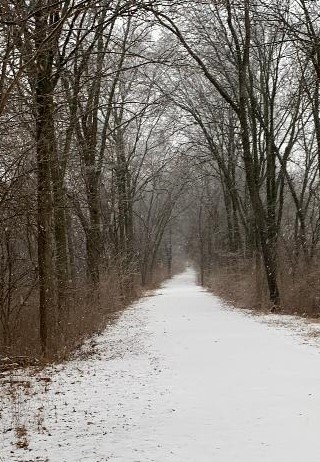
It’s snowing this New Year’s Day morning just north of Kansas City. The first thing on the list every day, even holidays, is to walk our faithful dog Boomer. Our walks are generally along the trail near our home.
The trail is a section of abandoned railroad, the Quincy, Omaha and Kansas City line, that proved good neither for farming nor the the subsequent housing additions that sprang up in the last decade of the twentieth century. It and the tree covered low spots that surround it have remained a somewhat overgrown patch of woods in an otherwise suburban wasteland.
All this is fine with the me and the dog.
The woods are thick enough that the subdivisions on either side of the trail are hidden from sight. We have seen squirrels, rabbits and deer on our trail and hear the call of owls and coyotes as well as the occasional tapping of a woodpecker on our walks.
The trail is an oasis of nature in the man-manipulated world that surrounds it. Today, snow falling, it is all the more quiet. And sweet to find ourselves in.
The quiet and the cold immediately brings to mind lyrics of the U2 song “New Year’s Day.”
All is quiet on New Year’s Day A world in white gets underway
As we continue our walk, another verse from a different poet comes to mind. Something from a poem I memorized for credit in junior high school. I was surprised how much of the poem I remembered from that long ago time, something about it apparently has stuck with me.
The poem? Stopping by Woods on a Snowy Evening by Robert Frost.
The poem has no satisfying conclusion, leaving much to the thoughts of the reader. I have considered the poem contemplative and forlorn, there is a certain air of sadness in the lines covered in dutiful resolve to keep on going. It speaks to how I feel on this New Year’s Day.
Like Icing on the Cake Or More Ornaments! I can still see branches!
December 7, 2020
The following is a little something I wrote almost a decade ago about Christmases when I was younger. Since that time, I have been deemed a Christmas curmudgeon or a Grinch…something that may be true, but here’s a holiday offering for you.
The things that go on top of Christmas trees is important; it says a lot about a person or their household.
Some folks have stars of various designs, other have Angels like the ones mentioned in the Good Book (and, yes, I know the Good Book alludes to a star, but how can you be sure the star on top of your tree is a good representation of the Star of Bethlehem? The law of averages suggests that any Angel would probably been included in the heavenly host. Therefore the Angel is, by default, imminently more Christmassy.)
There are some heathens that place a bow on the tree. I’m sure those soulless fiends used a bow because they couldn’t find an empty beer can or a losing lottery ticket as the tree-topper. Again, bows-atop-tree people should be avoided at all costs.
At our house, we had an Angel that sat atop our tree. No ordinary Angel, this one was electric, with it’s own cord and everything. My brother, who was pretty sure he knew how to do everything, was very meticulous about hiding the cord amongst the fake branches to preserve the illusion that the Angel was perched up there as if by magic.
This Angel was special: blond, clad in white and holding a candle in front of her with both hands ( the candle was really a small Christmas bulb, hence the need for the cord.)
After the lights and the garland and the ornaments were all placed on the tree. Out came the Angel, which Mom still had the package it came in so that the Angel would not get mangled with the other decorations in their 11 month slumber. It was somewhat like the moment the crown is brought out at a coronation, lots of “oohs” and “aahs.” Let the record show, I don’t believe I was ever recorded as “oohing” or “aahing” as I was the young skeptic in those days.
One Christmas, when I was very young, I remember my sister pleading with my mother to put tinsel on the tree. After the Angel was on, Mother relented. My brother and sister worked very hard to get the tinsel evenly distributed around the tree, which seemed like it took hours. Again, my brother, the eight year old engineer, also served as inspector on this job.
As the youngest and shortest of the Garrett children, and suffering from a short attention span and atrocious hand-eye coordination, I did my best contribute to the tinseling of the tree. My Mom, who was famous for finding deals on things and then buying in bulk, had apparently cornered the market on silver tinsel that year. Whatever I was doing wasn’t meeting my brother’s high standards in tinsel distribution and I was demoted to sitting on the couch to watch the other two sloppily apply little bit of silver to the tree.
I remember plainly that what has become known as the “Tinsel Incident” turned out to really ruin the Christmas Tree putting up for me. I left my brother and sister to organize the tree.
There was quite a bit of tinsel that didn’t stick to the tree and, in my absence, it was blamed on me. It became worse when we discovered that the old ElectroLux vacuum cleaner, “Ol’ Relaible,” didn’t really get the job done on stray tinsel. Even though I had been promoted to couch-sitting (my new take on the incident) and was not part of the tinseling crew, my protests were met on my Mother’s deaf ears. I was included in the rotation of tinsel patrol.
We had tinsel only one more year at our house after that. Us Garrett kids were sad to find out that they quit making tinsel in the following years. At least that’s what Mom told us…
A LATE THANKSGIVING THOUGHT
December 1, 2020
I do some of my best thinking when I’m walking the dog.
As Boomer and I made our way along the trail near our house, I was thinking about how far I have come in learning how to master (too strong a word) some of the tools of podcasting. In the early days of the podcast, I recorded interviews and other audio on my phone in Garage band. It was convenient because the phone was always in my pocket. It recorded the noises I needed it to, plus a bunch of other noises, too. And this is how I did it for over a year.
Then, one day in late summer of last year I got the idea that I wanted to interview Michael Wallis, author of several books, about one of my favorites by him, “The Lion of the West.” I found his website and clicked on the contact link and asked for an interview. Half expecting no response and halfway expecting a polite “no thanks” in a week or so, you could image my surprise when waiting in my in box the next morning was a message from the author himself. Not only did he suggest a date and time for said interview, he left his phone number to give him a call for the conversation.
Excited at the prospect of interviewing a renown writer faded to terror. “How am I going to pull this off?” A telephone interview was way over my level of expertise.
I googled “How to record a telephone interview.” I found no solutions there that I liked. It all involved spending money and a lot more than I was interested in spending. So, I turned to social media, begging for a solution from other podcasters.
A podcasting friend from Pittsburgh, Tim O’Brien, suggested this dohicky called a Zoom P-6. He described what it did and what it could do. His review was so glowing I’m not convinced he doesn’t own stock in the company. Convinced that if I was going to get this interview recorded I would have to step up and buy this piece of equipment.
Its ability to also record remotely turned out to be an added benefit. It really changed the sound of my podcast, giving me better audio quality for those interviews. Tim’s advice was a real gift.
But the real gift came a few months later. This thing came along called a world-wide pandemic. Suddenly travel was not quite as easy and people were not quite as ready to visit face to face. I soon found myself doing interviews by phone with people just across town. The real gift was the ability to continue to do the podcast and the interviews despite the pandemic.
As we neared the front door, the dog and I, I realized what a great turn Tim had done me. By encouraging me to get over my fears about learning one more gadget and my qualms about the cash, he really saved the podcast. Sure, it could have continued without the recorder, but it would have lost some of its dynamics and “feel.”
I stooped to let Boomer of his leash. I was thankful for a friend who’s advice released me from my own self-imposed low-tech leash.
Tim O’Brien is the host of “Shaping Opinion.” On his podcast they talk about the people, events and things that have shaped the way we think. @ShapingOpinion
A Collection of Stories about the Power of the Comeback…and Beyond
August 25, 2020
The Importance of Places That Don’t Exist Anymore
June 29, 2019
Finding You
For Brad: Unfinished Business
September 20th, 2018
My Uncle, The Cherokee National Treasure
June 6th, 2018
Like Icing on the Cake Or More Ornaments! I can still see branches!
December 7, 2020
The following is a little something I wrote almost a decade ago about Christmases when I was younger. Since that time, I have been deemed a Christmas curmudgeon or a Grinch…something that may be true, but here’s a holiday offering for you.
The things that go on top of Christmas trees is important; it says a lot about a person or their household.
Some folks have stars of various designs, other have Angels like the ones mentioned in the Good Book (and, yes, I know the Good Book alludes to a star, but how can you be sure the star on top of your tree is a good representation of the Star of Bethlehem? The law of averages suggests that any Angel would probably been included in the heavenly host. Therefore the Angel is, by default, imminently more Christmassy.)
There are some heathens that place a bow on the tree. I’m sure those soulless fiends used a bow because they couldn’t find an empty beer can or a losing lottery ticket as the tree-topper. Again, bows-atop-tree people should be avoided at all costs.
At our house, we had an Angel that sat atop our tree. No ordinary Angel, this one was electric, with it’s own cord and everything. My brother, who was pretty sure he knew how to do everything, was very meticulous about hiding the cord amongst the fake branches to preserve the illusion that the Angel was perched up there as if by magic.
This Angel was special: blond, clad in white and holding a candle in front of her with both hands ( the candle was really a small Christmas bulb, hence the need for the cord.)
After the lights and the garland and the ornaments were all placed on the tree. Out came the Angel, which Mom still had the package it came in so that the Angel would not get mangled with the other decorations in their 11 month slumber. It was somewhat like the moment the crown is brought out at a coronation, lots of “oohs” and “aahs.” Let the record show, I don’t believe I was ever recorded as “oohing” or “aahing” as I was the young skeptic in those days.
One Christmas, when I was very young, I remember my sister pleading with my mother to put tinsel on the tree. After the Angel was on, Mother relented. My brother and sister worked very hard to get the tinsel evenly distributed around the tree, which seemed like it took hours. Again, my brother, the eight year old engineer, also served as inspector on this job.
As the youngest and shortest of the Garrett children, and suffering from a short attention span and atrocious hand-eye coordination, I did my best contribute to the tinseling of the tree. My Mom, who was famous for finding deals on things and then buying in bulk, had apparently cornered the market on silver tinsel that year. Whatever I was doing wasn’t meeting my brother’s high standards in tinsel distribution and I was demoted to sitting on the couch to watch the other two sloppily apply little bit of silver to the tree.
I remember plainly that what has become known as the “Tinsel Incident” turned out to really ruin the Christmas Tree putting up for me. I left my brother and sister to organize the tree.
There was quite a bit of tinsel that didn’t stick to the tree and, in my absence, it was blamed on me. It became worse when we discovered that the old ElectroLux vacuum cleaner, “Ol’ Relaible,” didn’t really get the job done on stray tinsel. Even though I had been promoted to couch-sitting (my new take on the incident) and was not part of the tinseling crew, my protests were met on my Mother’s deaf ears. I was included in the rotation of tinsel patrol.
We had tinsel only one more year at our house after that. Us Garrett kids were sad to find out that they quit making tinsel in the following years. At least that’s what Mom told us…
A LATE THANKSGIVING THOUGHT
December 1, 2020
I do some of my best thinking when I’m walking the dog.
As Boomer and I made our way along the trail near our house, I was thinking about how far I have come in learning how to master (too strong a word) some of the tools of podcasting. In the early days of the podcast, I recorded interviews and other audio on my phone in Garage band. It was convenient because the phone was always in my pocket. It recorded the noises I needed it to, plus a bunch of other noises, too. And this is how I did it for over a year.
Then, one day in late summer of last year I got the idea that I wanted to interview Michael Wallis, author of several books, about one of my favorites by him, “The Lion of the West.” I found his website and clicked on the contact link and asked for an interview. Half expecting no response and halfway expecting a polite “no thanks” in a week or so, you could image my surprise when waiting in my in box the next morning was a message from the author himself. Not only did he suggest a date and time for said interview, he left his phone number to give him a call for the conversation.
Excited at the prospect of interviewing a renown writer faded to terror. “How am I going to pull this off?” A telephone interview was way over my level of expertise.
I googled “How to record a telephone interview.” I found no solutions there that I liked. It all involved spending money and a lot more than I was interested in spending. So, I turned to social media, begging for a solution from other podcasters.
A podcasting friend from Pittsburgh, Tim O’Brien, suggested this dohicky called a Zoom P-6. He described what it did and what it could do. His review was so glowing I’m not convinced he doesn’t own stock in the company. Convinced that if I was going to get this interview recorded I would have to step up and buy this piece of equipment.
Its ability to also record remotely turned out to be an added benefit. It really changed the sound of my podcast, giving me better audio quality for those interviews. Tim’s advice was a real gift.
But the real gift came a few months later. This thing came along called a world-wide pandemic. Suddenly travel was not quite as easy and people were not quite as ready to visit face to face. I soon found myself doing interviews by phone with people just across town. The real gift was the ability to continue to do the podcast and the interviews despite the pandemic.
As we neared the front door, the dog and I, I realized what a great turn Tim had done me. By encouraging me to get over my fears about learning one more gadget and my qualms about the cash, he really saved the podcast. Sure, it could have continued without the recorder, but it would have lost some of its dynamics and “feel.”
I stooped to let Boomer of his leash. I was thankful for a friend who’s advice released me from my own self-imposed low-tech leash.
Tim O’Brien is the host of “Shaping Opinion.” On his podcast they talk about the people, events and things that have shaped the way we think. @ShapingOpinion
A Collection of Stories about the Power of the Comeback…and Beyond
August 25, 2020
The Importance of Places That Don’t Exist Anymore
June 29, 2019
Finding You
For Brad: Unfinished Business
September 20th, 2018
My Uncle, The Cherokee National Treasure
June 6th, 2018
 Within the Realm